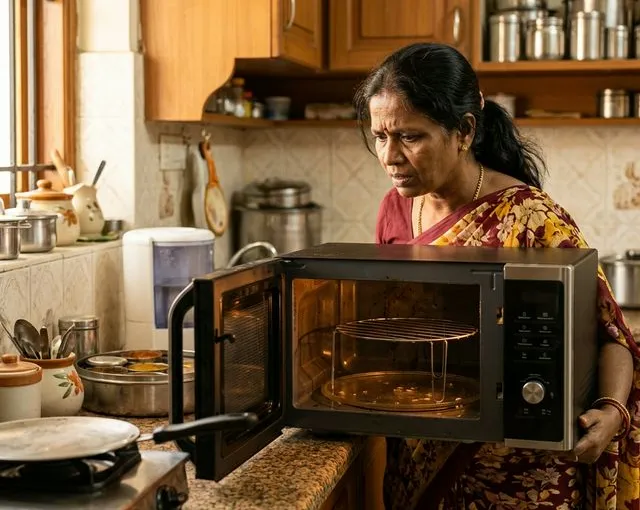
Troubleshooting Your Microwave: Why It's Not Heating and How to Fix It
Troubleshooting Your Microwave: Why It’s Not Heating and How to Fix It
It happens without warning. You put your leftover dal or last night’s rice into the microwave, set the timer, hear the usual hum — and then open it to find the food is still cold. The microwave ran, but it didn’t heat.
This is one of the most common microwave problems, and it often causes people to either throw out a working microwave or call a technician for something they could have fixed themselves with basic tools.
This guide walks you through the most common causes of a microwave that runs but doesn’t heat, how to diagnose each problem, and which ones are safe DIY fixes versus when to call a professional.
Safety Warning: Microwave ovens store dangerous high-voltage electricity in their capacitors — even when unplugged. Do not attempt to open the microwave cabinet unless you are experienced with high-voltage electronics and have properly discharged the capacitor. For internal component issues, always call a certified technician.
Step 1: First, Confirm the Problem Clearly
Before diagnosing, confirm exactly what is happening:
- Does the microwave turn on? (light, turntable, display working)
- Does the timer count down normally?
- Is there a humming sound during operation?
- Is there any burning smell or sparking?
- Is the door closing fully and latching firmly?
If the microwave is completely dead (no display, no light), the issue is likely a blown main fuse or power supply — not the heating system. Start with the door and fuse checks below.
Cause 1: Door Latch Issues (Most Common, Easiest Fix)
What’s happening:
Modern microwaves have 2–3 door interlock switches that must all engage correctly when the door closes. If any one of them fails, the microwave will run (turntable, light, timer active) but the magnetron (heating element) will be disabled as a safety measure.
This is the most frequent cause of “microwave runs but doesn’t heat” — especially in older units or those that have been dropped or bumped.
How to check:
- Close the door and listen for a clear click as the latch engages
- Try gently pushing the door inward while running — does heating return?
- Inspect the door hooks (the plastic tabs that press the interlock switches) — are any broken or bent?
DIY fix:
- If the door hooks are visibly broken, replacement door latches are available online for most Samsung, LG, and Panasonic microwave models (₹100–₹400)
- If the problem is in the interlock switches themselves, this requires opening the case — call a technician
Cause 2: Blown Fuse
What’s happening:
Microwaves have internal ceramic fuses that protect the electrical circuit from power surges. Indian power supply is particularly prone to fluctuations that can blow these fuses. A blown fuse will cause the microwave to be completely dead (no display, no turntable) — or in some cases, partial function without heating.
How to check:
- If the microwave is completely unresponsive (no display, no interior light), the main fuse is likely blown
- You can visually inspect the fuse if you can access the fuse holder without opening the main cabinet on your model
DIY fix:
Replacing a microwave fuse is possible if your model allows fuse access without opening the main cabinet. Fuses cost ₹20–₹50 and are specifications-specific (check the existing fuse for voltage and ampere rating before buying a replacement).
If the new fuse blows immediately after replacement, there is a deeper electrical fault — stop and call a technician.
Cause 3: Faulty High-Voltage Diode
What’s happening:
The diode converts AC power to DC power and doubles the voltage going to the magnetron. If it fails, the magnetron doesn’t receive enough voltage to generate microwave energy — resulting in the unit running silently without heating.
Signs of a faulty diode:
- Microwave runs but produces no heat
- You may hear the magnetron attempting to hum but producing a different, duller sound
- Sometimes accompanied by a loud buzzing instead of the normal operation hum
Is this DIY-safe?
No. The high-voltage diode sits in the high-voltage circuit near the capacitor, which can hold a lethal charge of 2,000+ volts even after the microwave is unplugged. This is a technician job.
Cause 4: Failed Magnetron
What’s happening:
The magnetron is the core component that actually generates microwave energy. It can fail due to:
- Age (most magnetrons last 7–10 years under normal use)
- Overheating from running the microwave empty
- Power surge damage
Signs of a failed magnetron:
- Microwave runs normally in every way but produces absolutely no heat
- Sometimes accompanied by a burning smell (especially a sweet or metallic burning)
- The door is fine, the fuse is fine, but nothing heats
Is this DIY-safe?
No. A magnetron replacement requires accessing the high-voltage section of the microwave and correctly grounding the capacitor before any work. Always call a certified technician.
Note on cost: A magnetron replacement typically costs ₹1,500–₹3,500 for parts plus labour. For older microwaves worth ₹3,000–₹5,000, this may not be economical — it’s often better to replace the unit.
Cause 5: Faulty Thermal Cutout or Thermoprotector
What’s happening:
Microwaves include thermal protection devices that shut off heating if the unit overheats. If this cutout fails permanently (rather than resetting after cooling), the microwave will run without heating even at normal temperatures.
Signs:
- Microwave ran fine, then stopped heating after a particularly long usage session
- Cooling down for 30 minutes and trying again didn’t fix it
Fix:
A thermoprotector replacement is a technician job, but it’s one of the simpler and cheaper internal repairs — usually ₹300–₹800 for parts plus labour.
Cause 6: Control Board Failure
What’s happening:
The control board manages all microwave functions. If it fails, it might send the wrong signals — allowing the turntable and display to work while not activating the heating circuit.
Signs:
- Microwave behaves erratically (random programs start, buttons behave unexpectedly)
- Nothing else explains the problem after checking all above causes
Fix:
Control board replacement is expensive — ₹2,500–₹5,000+ depending on brand and model. At this cost, evaluate whether a new microwave makes more sense.
What You CAN Do Safely Yourself
| Issue | DIY Safe? | What to Do |
|---|---|---|
| Door latch broken | ✅ Yes | Replace door hooks (₹100–₹400) |
| Main ceramic fuse | ✅ Partially | Replace if accessible without opening cabinet |
| Microwave running empty | ✅ Prevention | Never run empty — keep a cup of water inside |
| Cleaning interior | ✅ Yes | Warm water + vinegar solution, non-abrasive cloth |
| Checking power outlet | ✅ Yes | Test with another appliance; check for tripped breakers |
What Needs a Technician
| Issue | Why Professional Required |
|---|---|
| High-voltage diode | Lethal capacitor charge |
| Magnetron replacement | High-voltage access required |
| Thermal cutout | Internal access near capacitor |
| Control board | Complex wiring and calibration |
| Any internal component | Capacitor must be discharged first |
How to Extend Your Microwave’s Life
- Never run it empty — always put food or a cup of water inside, even for tests
- Use microwave-safe containers only — metal containers damage the magnetron
- Don’t slam the door — this is the number one cause of broken door latches and interlock switch damage
- Clean regularly — food splatter absorbs microwave energy over time, reducing efficiency
- Use a surge protector — Indian power fluctuations are a common cause of blown fuses and component damage
When to Call a Technician vs. Buy a New Microwave
| Microwave Age | Repair Cost | Recommendation |
|---|---|---|
| 0–3 years (under warranty) | Under warranty | Claim warranty first |
| 3–6 years | Under ₹1,500 | Repair makes sense |
| 3–6 years | ₹2,000+ | Weigh against replacement cost |
| 7+ years | Any significant repair | Buy new — older magnetrons often fail again soon |
FAQs
Why does my microwave run but not heat?
The most common causes are a faulty door latch, blown fuse, or failed high-voltage diode. Start with the door — check that it latches firmly with a clear click.
Is it safe to repair a microwave yourself?
Only external repairs like replacing door latches or the accessible ceramic fuse. Never open the microwave cabinet yourself — the internal capacitor holds dangerously high voltages even after unplugging.
How long do microwaves last?
Most quality microwaves last 8–12 years with normal use. Avoid running empty and use surge protectors to extend lifespan in Indian power conditions.
Can a microwave be repaired if the magnetron fails?
Yes, but it’s expensive. A magnetron replacement costs ₹1,500–₹3,500 in parts plus labour. For older microwaves, buying a new one is often more economical.
Why does my microwave spark inside?
Sparking is usually caused by metal utensils or foil inside, or by burnt food residue on the walls or the waveguide cover (the rectangular panel inside). Clean the waveguide cover — if it’s charred, replace it (available for ₹50–₹150 online).