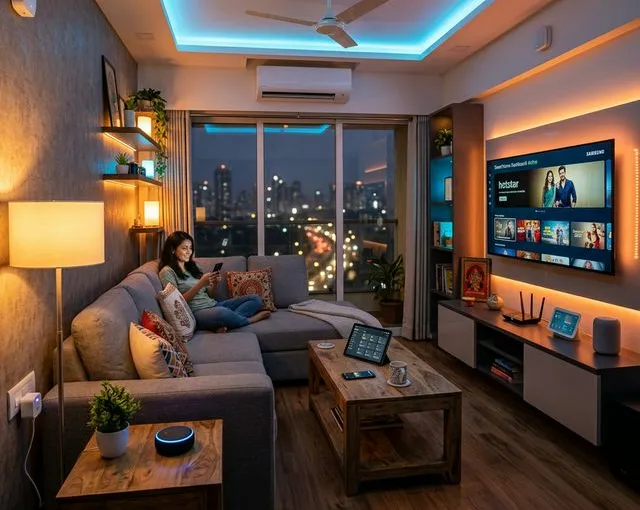
How to Build a Future-Proof Smart Home in India Without Rewiring
How to Build a Future-Proof Smart Home in India Without Rewiring
The Indian home automation market is crossing $13 billion — but most guides assume you’re designing a new home or ready to rewire everything. The reality for most Indian households is very different: you have an existing apartment with standard wiring, a mix of old and new appliances, and you want automation without tearing walls apart.
Good news: in 2026, you don’t need a single wire changed to build a genuinely useful smart home. Smart plugs, Wi-Fi switches, and voice-enabled devices now let you automate almost any appliance without an electrician.
Here’s how to do it practically and affordably.
The Core Philosophy: Retrofit, Don’t Replace
The smartest approach to home automation in an existing Indian home is to add intelligence on top of what already exists — rather than replacing appliances or rewiring switches.
Three product categories make this possible:
- Smart plugs — give any appliance a connected on/off switch
- Wi-Fi smart switches — replace existing switch plates to control lights and fans
- Smart bulbs/strips — add colour and brightness control to any light fitting
Each of these works with Alexa or Google Home for voice control, and with automation apps for scheduling.
Step 1: Start With a Smart Plug
If you only buy one smart home product, make it a smart plug.
A smart plug sits between your regular wall socket and any appliance. It makes that device controllable via an app, a voice assistant, or a schedule — without any wiring changes.
What you can control with a smart plug:
- Table fans, pedestal fans
- Geysers (especially useful — set to turn on 10 minutes before you wake up)
- TV sets, set-top boxes
- Laptop chargers and phone charging setups
- Air purifiers and humidifiers
- Older ACs (basic on/off scheduling)
Recommended smart plugs for India:
- Wipro Smart Plug — Works with Alexa and Google Home, reliable build quality, widely available online
- Anchor By Panasonic Smart Plug — Good quality from a trusted Indian brand, supports 16A for heavy appliances
- TP-Link Tapo P100 / P110 — Excellent app experience, energy monitoring on P110 variant
Real-world example:
Set your geyser to turn on at 6:00 AM every weekday via the app. By the time you wake up, hot water is ready — no waiting, no forgetting to switch it off, and no wasted electricity.
Step 2: Automate Your Lights With Wi-Fi Switches or Smart Bulbs
Lights are the most visible part of any smart home. There are two approaches:
Option A: Smart Bulbs (Easiest, No Electrician)
Replace existing bulbs with smart bulbs. They screw into standard fittings and connect directly to Wi-Fi. Control brightness and colour from your phone or voice.
Best smart bulbs for India:
- Wipro Garnet 9W Smart Bulb — affordable, warm-to-cool colour range, Alexa + Google Home compatible
- Philips Wiz Wi-Fi Smart Bulb — excellent app, 2700K–6500K colour temperature range
- Syska Smart Bulb — good budget option, available on Flipkart and Amazon India
Limitation: The wall switch must stay ON for smart bulbs to function. This can be a habit adjustment issue for Indian households where everyone hits the switch reflexively.
Option B: Wi-Fi Smart Switches (Better Long-Term)
Replace your existing switch plates with Wi-Fi-enabled switches. These work with any standard bulb and allow both wall-switch and app/voice control.
Best smart switches for India:
- Anchor By Panasonic Smart Switch Plate — designed for Indian wiring, multiple gang options
- Legrand ELIOT — premium build quality designed specifically for Indian homes
- Oakter Smart Switch — cost-effective, works well in Indian voltage conditions
Important: Smart switches require a neutral wire at the switch box. Many older Indian homes don’t have one. Check with an electrician before ordering — this is the one point where wiring needs to be verified (but not necessarily rewired end-to-end).
Step 3: Add a Voice Assistant Hub (Alexa or Google Home)
Without a central voice assistant, you’ll end up with multiple apps for multiple devices. A voice hub ties everything together.
Amazon Echo Dot (4th/5th Gen) — Best for Most Indian Homes
The Echo Dot is the most affordable entry into Alexa’s ecosystem. At ₹3,499–₹4,499, it connects all your Wipro, TP-Link, Anchor, and other Alexa-compatible devices and lets you control them with voice or routines.
Voice commands you can use from day one:
- “Alexa, turn off the geyser”
- “Alexa, dim the bedroom lights to 40%”
- “Alexa, good morning” (triggers a morning routine that turns on lights, reads weather, starts a news briefing)
- “Alexa, goodnight” (turns off all lights, switches off heaters)
Google Nest Mini — Better for Google Ecosystem Users
If your household uses Android phones heavily and relies on Google Calendar, Google Nest Mini integrates better. It’s equally capable and works with most Indian smart home brands.
Which to choose:
- Heavy Amazon Prime / Alexa music users: Echo Dot
- Android / Google Calendar / YouTube Music users: Google Nest Mini
- Both work equally well with smart plugs and switches from major Indian brands
Step 4: Automate Your AC (Without Replacing It)
Many Indian homes have older ACs without Wi-Fi capability. You can add smart control using a universal IR blaster.
How it works:
An IR blaster (a small device plugged into your wall socket or USB) learns your AC remote’s signals and replaces it — controllable via an app.
Recommended for India:
- Sensibo Sky — premium AC controller with energy tracking, geofencing (auto-AC when you’re almost home), and Alexa/Google Assistant support
- Tado Smart AC Control — European brand, works well with any split AC in India
- Oakter OakRemote — affordable Indian brand, works with most ACs
Real-world automation:
- Arriving home: When your phone’s GPS shows you’re 1km away, the AC turns on and cools the room before you enter
- Scheduled cooling: AC turns on at 10 PM to cool the bedroom before sleep, turns off at 6 AM
- Temperature-based: If the room sensor reads above 30°C and a family member asks Alexa, the AC turns on automatically
Step 5: Don’t Forget Security — Smart Video Doorbells and Cameras
This is often the step that delivers the most immediate value in Indian homes.
Recommended cameras for India:
- TP-Link Tapo C100 — ₹1,800–₹2,200, 1080p, motion detection, works without a subscription
- Mi 360° Home Security Camera 2K — excellent wide-angle view, 2K resolution, affordable
- EZVIZ Smart Doorbell — battery-powered, wide-angle, two-way audio, motion zones
You don’t need a DVR or complex cabling — all store footage on a microSD card or cloud with motion-triggered recording.
Smart Home Starter Pack for Indian Homes
Here’s an affordable, practical starting kit for an Indian 2BHK apartment:
| Product | Use | Approx Cost |
|---|---|---|
| 2× Wipro Smart Plug (16A) | Geyser + fan control | ₹1,600 |
| 4× Wipro Garnet Smart Bulb | Living room + bedroom lights | ₹2,000 |
| 1× Amazon Echo Dot | Voice control hub | ₹3,499 |
| 1× IR Blaster (Sensibo Air) | AC automation | ₹5,999 |
| 1× TP-Link Tapo C100 | Indoor security camera | ₹1,800 |
| Total | ~₹14,900 |
This gives you meaningful smart home automation in every major room of a 2BHK for under ₹15,000 — with no rewiring.
Common Mistakes Indian Buyers Make
1. Buying branded but incompatible devices
Not all smart devices work with Alexa or Google Home. Always verify compatibility before buying. Look for “Works with Alexa” or “Works with Google Home” badges.
2. Using different ecosystems across rooms
Using Alexa-compatible plugs in one room and Google-only devices in another creates two separate apps and no way to create unified routines. Pick one ecosystem and stick to it.
3. Skipping the router upgrade
Smart home devices work over Wi-Fi. If your router is old or the signal is weak in some rooms, devices will drop offline frequently. A dual-band router or a mesh system (like TP-Link Deco) makes a significant difference.
4. Overcomplicating automation early
Start with two or three devices and get comfortable. A geyser smart plug and smart lights controlled by Alexa already dramatically changes daily life. Expand gradually.
FAQs
Can I make my old appliances smart without replacing them?
Yes — a smart plug gives you scheduling and voice control over any existing appliance. IR blasters work with old ACs, TVs, and set-top boxes.
Which is better for India: Alexa or Google Home?
Both work well with Indian smart devices. Alexa has a wider product ecosystem in India. Google Home integrates better with Android phones and Google services. Either is a fine starting point.
Do smart plugs work with high-power appliances like geysers?
Yes, but make sure to buy a 16A rated smart plug for high-power appliances like geysers, ACs, and washing machines. Standard 6A smart plugs are for low-power devices only.
Is smart home automation expensive in India?
A meaningful starter setup costs around ₹12,000–₹18,000 for a 2BHK. Individual devices start from ₹800 for a basic smart plug. You can start small and expand gradually.
What internet speed do I need for a smart home?
Most smart devices need very little bandwidth. A 25–50 Mbps connection is more than sufficient for a full smart home setup. The more important factor is reliable Wi-Fi coverage throughout your home.